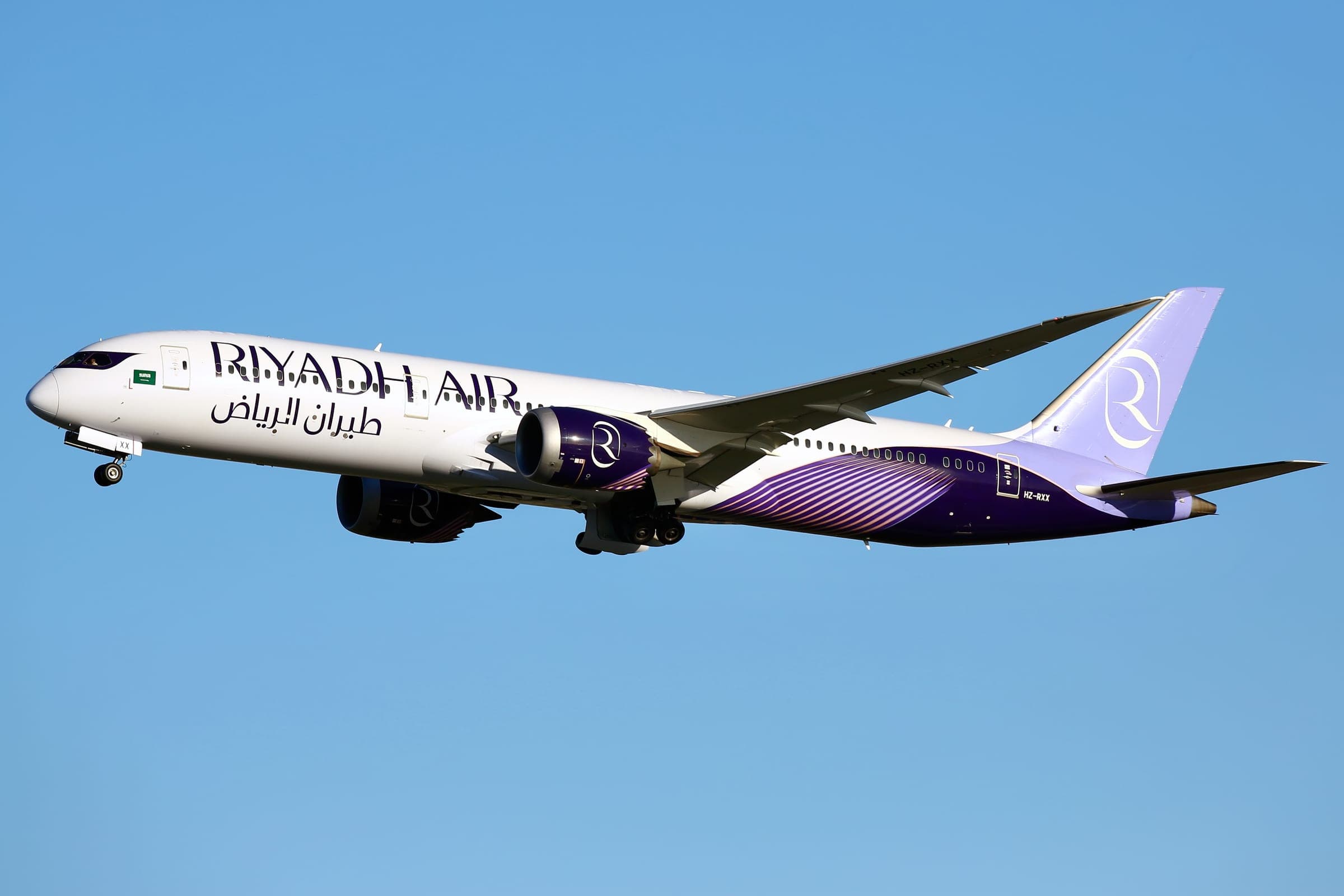
Riyadh Air is the rarest thing in commercial aviation: a well-funded, wide-bodied, global-ambition airline being built from nothing, in public, right now. It flew its first revenue service in mid-2026 and intends to reach more than 100 destinations by 2030. For anyone weighing a Gulf career, it is the one employer in the region whose entire crew base is still being assembled, which makes it both the biggest opportunity and the one with the least track record to judge it by.
This is what Riyadh Air is in 2026, who it is hiring, what stands out about working there, and the specific caveats of joining an airline this early.
The fundamentals
Riyadh Air is a Saudi flag carrier project backed by the Public Investment Fund, based at King Khalid International Airport in Riyadh. It launched commercial operations in mid-2026, opening with long-haul intent, its early network reportedly built around routes including London Heathrow, flown by the Boeing 787-9.
The orderbook is built for global reach. Once outstanding commitments are finalised, it comprises roughly 67 Boeing 787s, 31 Airbus A350-1000s and 60 A321neos, a deliberate split of long-haul widebodies for the intercontinental network and narrowbodies for domestic, regional and shorter medium-haul flying. It began with a small number of 787-9s and a short destination list, with trade reporting pointing toward around eight aircraft and 22 destinations by early 2027.
Who it is hiring, and how
Because the airline is still building its crew base, hiring is broad and active across categories.
Flight deck. Riyadh Air is recruiting experienced pilots on the international market, running roadshows well beyond the region, including in South America. This is the expected pattern for a launch widebody carrier: it needs command-qualified and type-experienced pilots before it has had time to grow its own, so the near-term openings favour experienced 787 and, in time, A350 crews rather than low-hour entrants.
Cabin crew, at scale. The airline has signalled cabin crew recruitment in the thousands as the network expands. Its Nawat training programme runs an eight-month curriculum covering safety, technical skills, language and service standards, with all cabin crew based in Riyadh, accommodation provided near the airport and transport to the crew centre.
The national pipeline. In parallel, Riyadh Air is building a Saudi pilot workforce for the long term through an employment-linked overseas scholarship with Embry-Riddle Aeronautical University, a degree-integrated pathway for Saudi cadets. As with the other Saudi carriers, the ab-initio national pipeline runs alongside experienced international hiring rather than replacing it.
The airline is also building training infrastructure in-house, including an ordered A321neo flight training device, a signal that it intends to run its own type training rather than depend indefinitely on outside providers.
What stands out versus the established Gulf carriers
Three things distinguish Riyadh Air from Emirates, Etihad and Qatar as an employer in 2026.
Pay at the top of the region. Riyadh Air is paying at or above its established Gulf peers to attract experienced crew quickly, with captain packages among the highest in the current market. When an airline needs to build a command cadre fast, it pays for it, and right now Riyadh Air does.
A blank-slate seniority list. This is the genuinely unusual part. At a mature carrier you join at the bottom of a decades-deep seniority list, and command can be eight to twelve years away. At an airline building its list from scratch, early joiners sit near the top of it. For the right experienced pilot, that can mean faster command and better long-term roster and base position than an equivalent move to an established carrier. Seniority is the currency of an airline career, and joining early is the one moment it is cheap.
A brand-new fleet and product. No legacy aircraft, no ageing cabins, a fleet of 787s, A350-1000s and A321neos and a product designed from a clean sheet. For crew who value flying new metal, that is a real draw.
The caveats of joining this early
The same newness that creates the opportunity creates the risk, and it should be weighed honestly.
Launch terms are not steady-state terms. Reported Riyadh Air contracts guarantee flight hours only into late 2026 during ramp-up, after which flight pay reverts to hours actually flown. For a carrier still building its network, the gap between guaranteed and actual hours can be material, and it falls on the variable part of the package. Anyone signing should model earnings on post-guarantee hours, not launch-phase guarantees.
Rosters and rules are still settling. Advertised patterns, including commuting rosters, may not hold in practice during the early operation, when schedules are volatile and the airline is learning its own network. Terms at a launch carrier move in a way they do not at a fifty-year-old airline.
Contract specifics carry real exposure. Reported terms peg pay to the US dollar without exchange-rate protection, and elements such as profit share remain undefined while the airline is pre-profit. Housing is paid as a cash allowance rather than provided, which some joiners have described as tight for family accommodation in Riyadh. None of these are disqualifying, but they are the fine print that decides whether the headline package delivers.
Who it fits
Riyadh Air fits an experienced pilot who can join near the top of a new seniority list and is comfortable trading the certainty of an established carrier for faster progression and top-of-market pay at a still-unproven one. It fits cabin crew willing to be part of a large, ground-up buildout. It is less suited to anyone who needs settled rosters, a long track record to evaluate, or the reassurance of a mature airline's steady-state terms. The upside is real and specific. So is the launch-phase risk, and both should be priced in before signing.
A note on sourcing
Fleet, network and hiring detail here are drawn from 2026 airline announcements and trade reporting, including orders firmed up at the 2026 Farnborough air show, alongside Riyadh Air's own recruitment and training material. A launch carrier's fleet, network and terms move quickly, so treat specific figures as accurate to 2026 reporting and confirm current detail against Riyadh Air directly before acting on it.