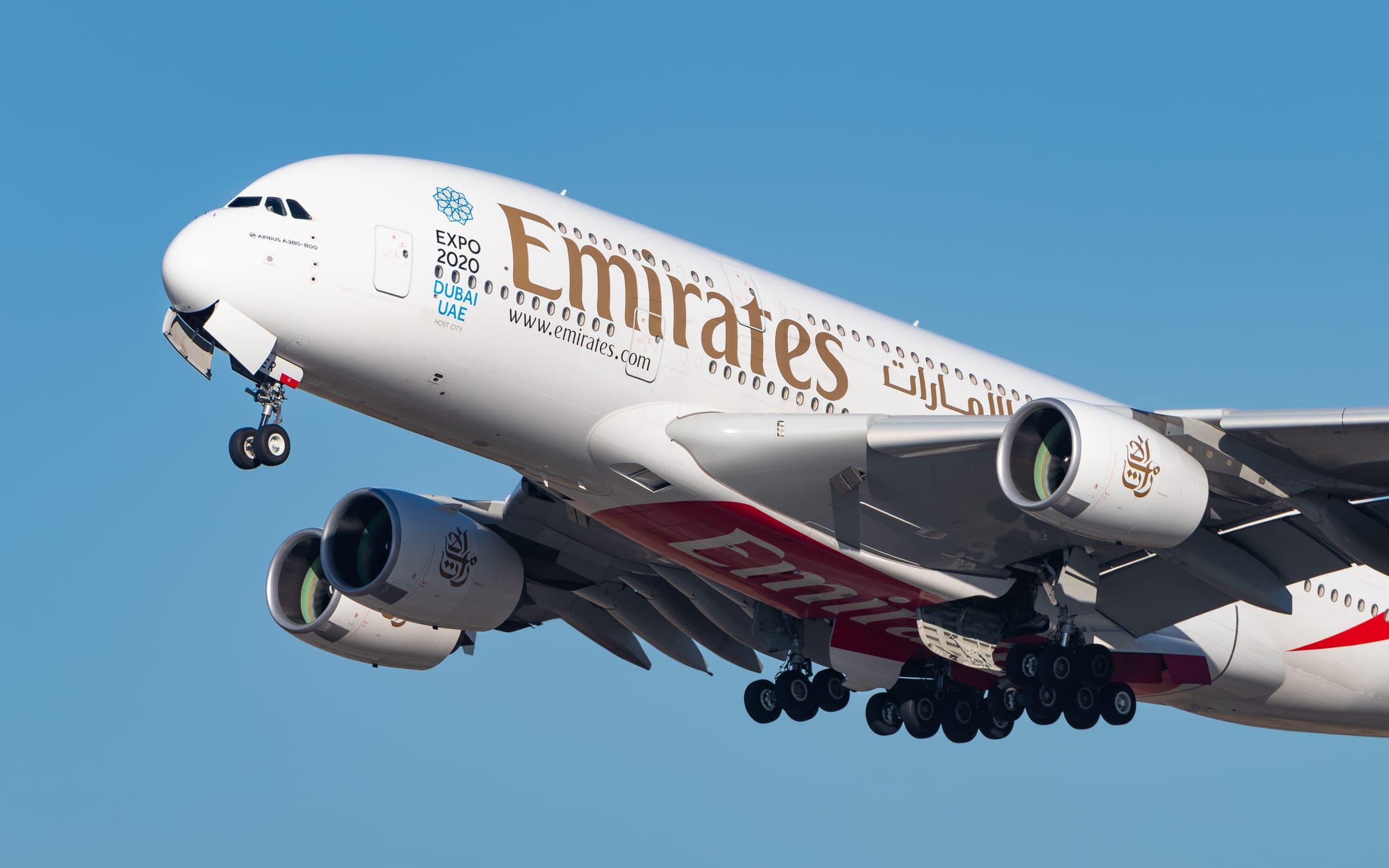
Ask a Dubai 777 captain and a Doha A350 captain to compare monthly net, and the numbers land within a few hundred dollars of each other. Ask them what they are worth after ten years and the gap opens to six figures. That gap has almost nothing to do with the headline salary either airline quotes at interview. It comes from three things: how fast you get the fourth bar, whether your employer puts money into a fund with your name on it, and how much of your package is paid as hours rather than as basic.
There is also an asymmetry readers keep tripping over. Emirates does not operate a narrowbody. Its fleet is A380, 777 and the A350-900 that entered service from late 2024. Qatar Airways runs A320-family metal alongside A330, A350, 777 and 787. So "narrowbody versus widebody" is not an Emirates-versus-Qatar question at all. In Dubai, the narrowbody conversation is flydubai. In Doha, it is an internal fleet-bid question, and it is the fastest route to a command in the Gulf.
Same rank, same fleet: the monthly numbers
Both countries levy no personal income tax and both currencies are pegged to the dollar, at 3.6725 for the dirham and 3.64 for the riyal, so monthly figures convert cleanly and neither carrier carries an FX risk premium.
| Rank / fleet | Emirates (AED/month) | Qatar Airways (QAR/month) | USD equivalent |
|---|---|---|---|
| FO, widebody: basic | 14,000–16,500 | 18,000–22,000 | 3,800–6,000 |
| SFO / senior FO: basic | 18,000–21,000 | n/a as separate grade in most reporting | 4,900–5,700 |
| Captain, widebody: basic | 26,000–32,000 | 28,000–34,000 | 7,100–9,300 |
| Captain, A320: basic | no fleet | 24,000–28,000 | 6,600–7,700 |
| Captain, widebody: total cash incl. housing and typical hours | 52,000–62,000 | 50,000–60,000 | 13,700–16,900 |
| FO, widebody: total cash incl. housing and typical hours | 30,000–36,000 | 30,000–38,000 | 8,200–10,400 |
Read the bottom two rows as the useful ones. On a like-for-like widebody command, the two carriers are effectively at parity, with Emirates a little ahead at the top of the range and Qatar a little ahead on first officer basic. Anyone quoting a clean 20 per cent advantage either way is comparing a package with housing to a package without it.
Flying pay is where the packages actually diverge
Emirates pays a per-hour flying rate on top of basic, roughly AED 175–210 for a first officer and AED 330–400 for a captain, against rosters that in practice sit around 80 to 85 credit hours in a normal month. That is a meaningful share of pay: a captain flying 85 hours at AED 360 is earning about AED 30,600 in flight pay against a basic of perhaps AED 29,000.
Qatar's structure has more variation in the reporting. Recruiter material describes a monthly basic plus productivity pay for hours flown above a threshold, with captain rates in the QAR 300–380 band. Pilot community reporting since the post-2023 pay revisions describes both the threshold and the rate as having moved, and not uniformly across fleets. We could not source a 2026 threshold figure we would stand behind, so treat the Qatar flight-pay line as directional and ask for the specific fleet schedule in writing at offer stage.
The behavioural point matters more than the arithmetic. A high-hours month in Dubai pays visibly better. A light month, or one lost to sickness or training, costs more.
Housing: keys in Doha, cash in Dubai
Emirates offers company accommodation or a cash allowance. Where taken as cash, captain-grade housing runs roughly AED 16,000–19,000 a month and first officer grade AED 11,000–13,500. In a Dubai rental market that has been running hard since 2022, pilots taking cash and living further out have been pocketing the difference; those wanting a villa near a decent school have often been topping up.
Qatar Airways leans towards provided, furnished accommodation, particularly for new joiners, with a cash allowance in the QAR 12,000–16,000 range at captain grade where it is offered. Doha rents are lower than Dubai's, so provided housing is less of a constraint on lifestyle than pilots expect, but it is also less convertible into savings.
Education support is the underrated line. Emirates' schooling assistance for pilot grades is the more generous of the two by most accounts, in the region of AED 45,000–60,000 per child per year with a cap on children and age. Qatar's equivalent is reported as tighter and more grade-dependent. For a captain with two school-age children, that difference can outweigh the entire monthly basic gap.
End of service: a fund versus a formula
This is the largest structural divergence and the one candidates research least.
| Emirates | Qatar Airways | |
|---|---|---|
| Mechanism | Group provident scheme, employer plus employee contributions | Statutory end-of-service gratuity under Qatar labour law |
| Employer input | roughly 12–15% of basic, rising with length of service | none: gratuity is a formula, not a contribution |
| Employee input | typically 5% or 7% of basic, elected | none |
| Accrual basis | invested balance | about 3 weeks of basic per year of service |
| Effect over 10 years | compounding on a rising basic | linear, and pegged to final basic |
Ten years at Emirates on a captain's basic with combined contributions near 20 per cent builds a materially larger balance than ten years of three-weeks-per-year gratuity in Doha, even before investment return. The UAE has additionally been moving employers towards regulated savings schemes as an alternative to statutory gratuity, which reinforces the direction of travel. Qatar's gratuity remains a statutory minimum with no employer-matched fund for expatriate pilots.
Add the Emirates Group profit share, which in recent record years has been announced at around 20 weeks of basic pay, and the long-tenure comparison stops being close. It is a bonus, not a contractual entitlement, and it went to zero in the pandemic years. Qatar Airways has paid performance bonuses in strong years too, but the amounts are less consistently documented and we would not put a range on them.
Training bonds
Both carriers bond type ratings. Emirates typically amortises over three years, with exposure most commonly reported in the AED 120,000–180,000 band and reduced or waived in some direct-entry campaigns. Qatar's bonds are reported over a similar three-year term with a wider spread, from around QAR 150,000 to figures above QAR 250,000 depending on fleet and joining route. Qatar also carries a reputation for firmer enforcement on early exit, a legacy of the pre-2020 no-objection-certificate regime. The NOC requirement was removed in 2020, so a resignation is now a notice-period and bond-repayment question rather than a permission question, and candidates should read the repayment schedule rather than the recruiter's summary of it.
Time to command
Qatar upgrades sooner. The A320 fleet is the mechanism: it gives the airline a place to season new captains and gives first officers a command they can actually bid for. Realistic Doha timelines run four to seven years from joining as a first officer, with the airline's own messaging closer to three or four and pilot reporting closer to five to seven. Direct-entry captain hiring on the A320 has been open in most recent cycles.
Emirates has no such rung. Command means a widebody left seat, and the sequence runs first officer to senior first officer to captain against a seniority list, which has historically meant six to nine years and considerably longer in slow-growth periods. Delivery timing matters here: the A350-900 induction and the still-delayed 777X are the two things that could compress it.
Meanwhile the third force is pulling on both. Riyadh Air is building a widebody fleet from a zero base: Boeing confirmed 67 787s in total on 20 July 2026 after the carrier exercised options on 28 more and converted 20 of them to the -10, and Airbus confirmed 31 firm A350-1000s the same day, within a commitment for up to 50. Saudi start-up and expansion hiring is the main reason Gulf upgrade timelines have shortened at all since 2023, because it creates the attrition that moves the list.
So who pays more
- Newly upgraded captain, same joining year: Qatar Airways, clearly. Monthly cash is comparable, but a Doha pilot commanding at year five while the Dubai pilot is still a senior first officer at year seven earns two extra years at captain rates. That is roughly USD 100,000 to 140,000 of cumulative difference that never gets recovered.
- Senior widebody captain, ten years plus: Emirates. Higher top-of-range monthly cash, a funded provident scheme instead of a gratuity formula, stronger education support and a profit share that in good years adds four to five months of basic.
- Direct-entry captain arriving with the rating and the hours: close to a coin toss on cash. Decide it on fleet and roster. Doha offers the A320 with shorter duties and more nights at home; Dubai offers A380 and 777 long haul with fatter flight pay in heavy months.
- Narrowbody: Qatar wins by default, since Emirates has none. Against flydubai, whose captain packages sit lower than either flag carrier, Qatar's A320 command is the better-paid narrowbody seat in the region.
- First officer, first three years: marginally Qatar on basic, marginally Emirates once housing taken as cash and provident contributions are counted.
Where the sources disagree, and why
- Aggregator totals versus line-by-line reporting. Self-reported aggregator data shows Emirates captain figures well above USD 200,000 a year. Community line-item reporting produces lower numbers. Both can be right: the high figures include housing, provident contributions and profit share, the low ones are cash-in-hand.
- Qatar productivity pay. Recruiter documents and pilot forums do not agree on the current hours threshold or whether it is uniform across fleets. Named conflict, unresolved here.
- Time to command. Airline messaging and pilot experience differ by roughly two years at Qatar. The airline is quoting the fast case.
- Bond size. Qatar bond figures in circulation vary by more than QAR 100,000. Fleet and joining route explain some of it, and the rest is age of the source.
Methodology and confidence
Neither Emirates nor Qatar Airways publishes a pilot pay scale. Everything above is aggregated from carrier careers material, recruiter listings, pilot community reporting and salary aggregators, weighted in that order, plus published labour law for the end-of-service mechanisms and manufacturer order announcements for the Saudi fleet picture.
These are ranges rather than quoted rates. Pay at both carriers moves with each recruitment cycle, and the figures here were compiled from sources accessed in May 2026. Use them to orient a negotiation, and check any specific number against the offer in front of you.
Firmest items: the structural comparison of a funded provident scheme against statutory gratuity, the absence of any Emirates narrowbody, and the direction of the time-to-command difference. Middling: the monthly cash bands, which are accurate as bands but move with each recruitment cycle. Weakest: Qatar's productivity-pay threshold, both carriers' current bond quantum, and Qatar bonus levels. Fleet detail throughout is from manufacturer and carrier announcements.